
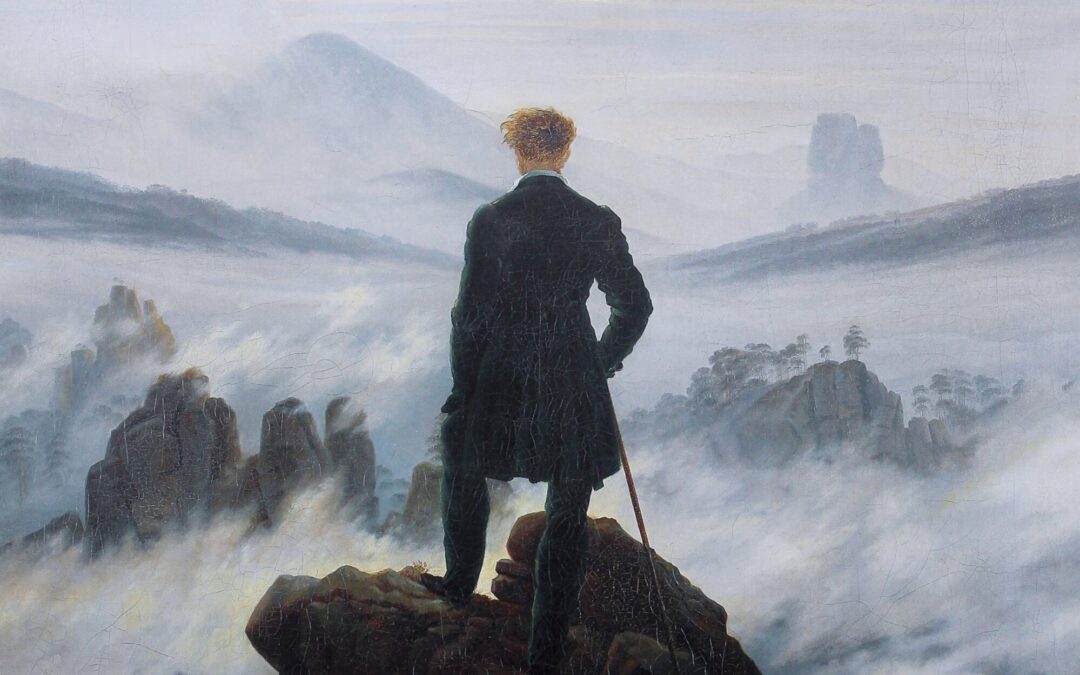
Northern India, early 1503
I have been on the road from Delhi for six weeks. The trade routes through this country are ancient in a way that the trade routes of Europe are not: they carry the memory of everything that has ever moved along them, spice and silk and manuscript and, underneath all of it, the older movement of ideas from one civilization to another that leaves no physical trace but that I can feel in the conversations I have along the way.
The scholars I have been meeting are different from the scholars I knew in Florence, different from the Islamic scholars of Damascus, different from the Byzantine scholars of Constantinople. They have a relationship to the self, to the nature of consciousness, to the question of what the self actually is, that none of the Western traditions I know have developed in quite this way. The question of whether the individual self is the fundamental unit of existence or whether it is a temporary, contingent, ultimately permeable arrangement: this is a question the Western traditions approach and then back away from. Here it is the center.
I am asking this question for reasons that are not entirely theoretical. Something is happening to the body I have inhabited for forty-five years that I do not have a framework for. I look at my hands in the morning light and they are the hands of a man approaching sixty, perhaps beyond. I left Florence at thirty-four. Eleven years have passed. The mathematics does not hold.
I am heading into the mountains. There is something in the mountains. I can feel it pulling me toward it through sheer gravity.